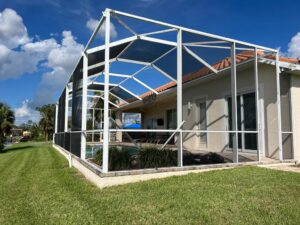
Quick Maintenance Schedule
- Monthly: ground-level visual check of screens, doors, and drainage
- After severe weather: document new tears, looseness, impact, or movement
- Every few months: clean accessible surfaces using enclosure-compatible methods
- At least annually: review mesh, spline, doors, hardware, fasteners, coating, gutters, and visible aluminum conditions
- Any time a safety issue appears: keep clear and contact the appropriate qualified provider
This schedule is a practical reminder, not a substitute for manufacturer instructions, inspection, engineering advice, or trade-specific service.

1. Inspect Screen Mesh and Spline
From the ground, look for torn, loose, sagging, brittle, or discolored mesh. Check for spline pulling away from the frame channel. Repeated panel failure can involve mesh, spline, channel condition, exposure, or installation factors and should not automatically be treated as a single-panel problem.
2. Check Screen Doors and Hardware
Open and close accessible doors normally. Note dragging, binding, slamming, gaps, loose handles, failed latches, damaged sweeps, or closer problems. Do not force a door that appears misaligned or connected to a damaged frame.
3. Review Visible Fasteners and Connections
Look for rust stains, corrosion, missing heads, looseness, separation, or coating failure around visible fasteners and connection points. Do not tighten, drill, or replace structural connections based on generic instructions.
For component details, use the pool cage hardware guide.
4. Watch Coating and Aluminum Conditions
Document peeling, bubbling, chalking, exposed aluminum, corrosion, localized bending, separation, or repeated movement. Coating, fastener, and aluminum conditions can be connected, so the appropriate scope should be based on inspection.
5. Keep Gutters and Drainage Areas Observable
From a safe location, note overflow, leaks, sagging, separation, blocked visible outlets, or water collecting where it did not before. Do not climb the enclosure or roof to clean or inspect elevated gutters.
6. Clean Without Damaging the Enclosure
Use enclosure- and screen-compatible cleaning guidance for accessible areas. Avoid harsh chemicals, aggressive pressure, sharp tools, or methods that can damage mesh, coating, spline, seals, landscaping, or nearby pool equipment. Follow manufacturer instructions for any product used.
7. Perform a Ground-Level Check After Severe Weather
Wait until conditions are safe. Photograph new tears, loose panels, door problems, debris impact, coating damage, gutter changes, visible fastener issues, and bent or separated aluminum. Keep away from power lines, electrical hazards, sharp metal, unstable sections, and fallen trees.
Maintenance Conditions That Need Prompt Attention
- A door that will not close or latch
- Multiple loose or torn panels
- Fasteners or connections with visible movement or heavy corrosion
- Bent, separated, or unstable-looking aluminum
- Electrical hazards, fallen trees, or overhead debris
- Gutter or drainage failure causing active property concerns
Electrical, roofing, tree, pool-equipment, foundation, and engineering conditions require the appropriate qualified provider.
Frequently Asked Questions
How often should a pool screen enclosure be inspected?
Complete a brief ground-level check monthly and after severe weather, then perform a more complete review at least annually. Increase the frequency when the enclosure is older, exposed to coastal conditions, surrounded by vegetation, or already showing deterioration.
Can maintenance prevent all screen tears or storm damage?
No. Maintenance can identify deterioration and operation problems earlier, but it cannot prevent every impact, material failure, or severe-weather loss and does not make an enclosure hurricane-proof.
Should I climb the enclosure to inspect it?
No. Do not climb or walk on a screen enclosure. Use ground-level observations and qualified providers for elevated, unstable, structural, electrical, or otherwise unsafe conditions.
Use the Printable Checklist
For a condensed version that can be printed and used during routine ground-level checks, open the free pool cage and screen enclosure maintenance checklist.
Request an Enclosure Inspection
If routine maintenance reveals screen, door, hardware, fastener, coating, drainage, or eligible aluminum conditions, request an estimate. The available scope is confirmed after inspection.